UCLA · Bio-Inspired Elastic Tail Dynamics
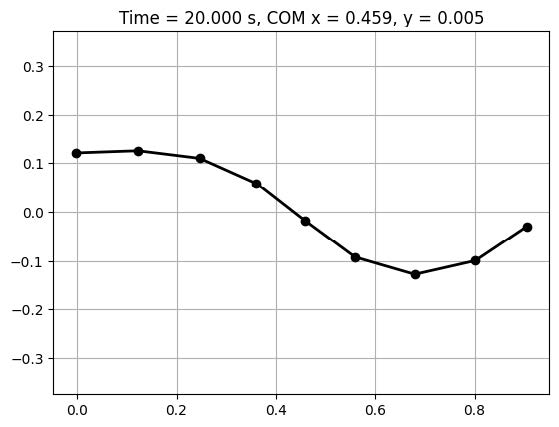
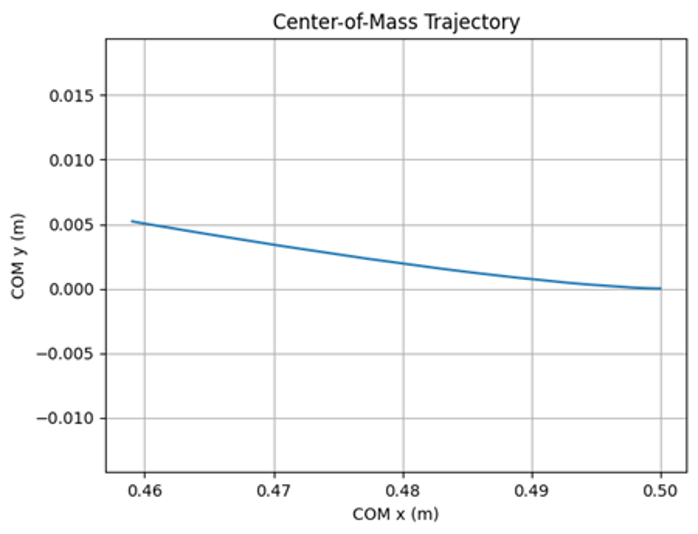
Developed a discrete elastic rod (DER) simulation framework for a bio-inspired tail actuated by a traveling curvature wave in low-Reynolds-number viscous fluids — motivated by biological swimmers such as fish, eels, and flagella where viscous forces dominate inertia. The tail was discretized into 9 nodes and 8 edges with an annular cross-section (E = 70 GPa), featuring heterogeneous bending stiffness (stiffer head, softer tail) and an amplitude envelope increasing toward the distal end.
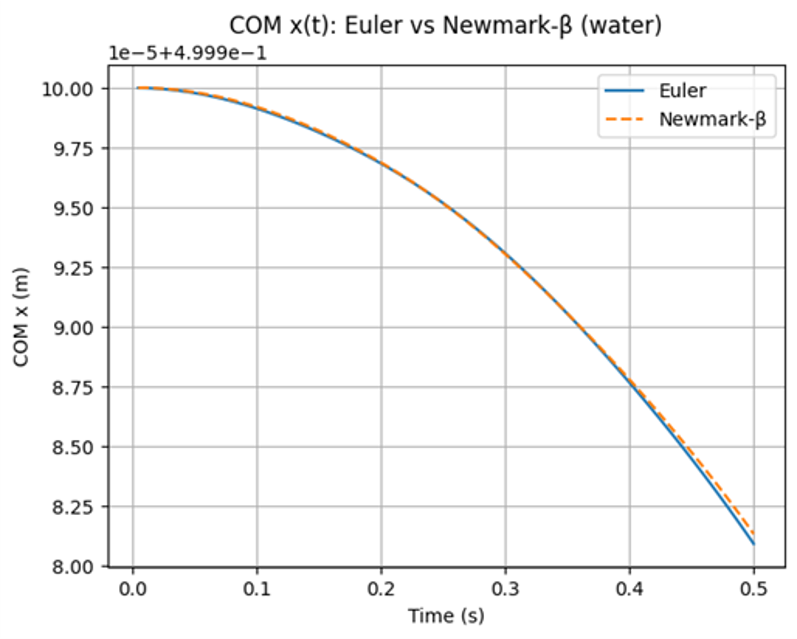
Two time integration schemes were implemented and cross-validated: a fully implicit Backward Euler method (Newton–Raphson solver) and a Newmark–β scheme (β = 0.5, γ = 0.5). Both produced nearly identical center-of-mass trajectories, confirming numerical stability and accuracy. Anisotropic Stokes-like viscous drag was modeled with a drag ratio α ≈ 5 between normal and tangential components, capturing the asymmetric force generation essential for net propulsion in low-Re regimes.
A 192-case parametric sweep was conducted across stiffness, geometry, density, viscosity (water vs. glycerol), curvature amplitude (κ = 0.8, 1.2), and actuation frequency (1.0–2.0 Hz). Key findings: propulsion scales nearly linearly with both curvature amplitude and frequency; stiffness plays a secondary role within the tested range; and glycerol-like environments yield net displacements roughly three orders of magnitude larger than water — quantitatively demonstrating the dominant role of viscous coupling in soft locomotion.